What “working” can realistically mean
Most competitor reviews answer this question with a yes and a list of benefits. A more useful answer splits “works” into things the ingredients have shown in humans and things no supplement can do.
| Goal | Can Visivra’s ingredients help? | Evidence |
|---|---|---|
| Less screen-related eye strain and fatigue | Likely | 6-month RCT; RCT |
| Higher macular pigment | Yes, over months | meta-analysis |
| Better glare recovery and contrast | Possible | RCT |
| Focusing-muscle fatigue in screen work | Possible | 12-week RCT |
| Slower progression of intermediate AMD | Use AREDS2 dosing under a doctor | NEI |
| Fix nearsightedness or reading blur | No | NEI |
| Reverse cataracts or glaucoma | No | NEI; NEI |
Who is most likely to notice a difference
- Heavy screen users with tired, strained eyes by evening. See Visivra for gamers and eye strain from your phone.
- People who rarely eat leafy greens, whose macular pigment may be low (NEI).
- Adults bothered by glare from screens or headlights; see night driving.
- Older adults wanting daily nutrition alongside regular exams; see Visivra for seniors.
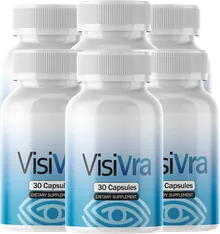
Best Visivra price today: 6 bottles at $49 each (save $780) or 3 bottles at $69 each with free US shipping. One-time payment, no autoship, 60 days to decide.
Check Today’s Discount ›Who probably won’t notice much
- People whose main issue is reading blur after 40, which is presbyopia and needs reading glasses (NEI).
- People who already eat lots of greens and take a lutein supplement.
- Anyone expecting change in a week.
How to test Visivra properly in 90 days
- Week 0: rate three things from 1–10: end-of-day eye tiredness, glare at night, how often you need to rest your eyes.
- Daily: one capsule with a meal, same time each day.
- Day 30: re-rate. Small or no change is normal; see 30-day results.
- Day 55: re-rate again. If nothing has shifted, decide now so you’re inside the 60-day guarantee.
- Day 90: final rating. Macular pigment studies typically ran this long or longer.
Keep the habits that help regardless: the 20-20-20 rule, full blinks and good lighting (CDC).
Why supplement trials look different from drug trials
Drug trials test one active ingredient in one standard dose. Supplement trials often test combinations and different doses, so their results can only be applied to a similar formula. The screen-time trial tested lutein, zeaxanthin and meso-zeaxanthin (PubMed); the bilberry trial tested a bilberry extract (PubMed); and the combination trial tested anthocyanin, astaxanthin and lutein together (PubMed). Visivra uses the same ingredient families, but without published amounts we cannot say its dose matches any of them. That is the honest limit on “does it work.”
Signs it may be working
- Your eyes feel less tired at the end of a long screen day.
- You recover faster after looking at bright lights or headlights.
- You need fewer rest breaks to keep reading comfortably.
- Dim rooms feel a little easier.
Signs it is probably not the answer for you
- Nothing changes after 90 days and your habits have not changed either.
- Your main problem is blur that needs a new prescription (Visivra for blurry vision).
- You have a diagnosed condition that needs medical treatment.
Placebo effect and fair testing
When you expect a supplement to help, you may feel better for reasons unrelated to the capsule, which is why trials use placebos. You can reduce this bias at home by rating your symptoms before you start, using the same questions each time and changing only one thing: don’t start new glasses, drops and a supplement in the same week. Ask a family member whether they notice you squinting or rubbing your eyes less.
What your eye doctor can measure
Standard eye exams can check visual acuity and the retina. Some clinics can also measure macular pigment, which is the most direct way to see whether lutein and zeaxanthin intake has changed anything (PubMed). It is not routine, so ask your eye doctor if it is available. Whatever you decide, keep up regular dilated exams (NEI).
Why it’s worth trying anyway
The ingredient choices are sensible: the AREDS2 carotenoid pair plus antioxidants tested in screen workers. There’s no subscription, and the guarantee makes the trial low-risk. The 3-bottle package covers the full 90-day test at $69 a bottle with free shipping. Start your 90-day Visivra test.
FAQ
Does Visivra really work?
Its ingredients have human trials showing better eye comfort and macular pigment. Results vary, and it won’t fix refractive errors or eye disease.
How quickly does Visivra work?
Some people notice comfort changes in weeks; macular pigment builds over 2–6 months.
Has Visivra been clinically tested?
No trial of the finished product has been published. Its ingredients have been tested individually and in combinations.
What if Visivra doesn’t work for me?
Request a refund within 60 days of purchase through support.
Sources
- PubMed: Macular carotenoid supplementation improves visual performance, sleep quality and physical symptoms in people with high screen time (Foods, 2017)
- PubMed: Anthocyanin, astaxanthin and lutein on eye functions, a randomized placebo-controlled study (J Clin Biochem Nutr, 2021)
- PubMed: Antioxidant supplementation, macular pigment optical density and visual function, a network meta-analysis (Adv Nutr, 2024)
- PubMed: 12 weeks of bilberry extract and ciliary-muscle findings in visual display terminal workers (Nutrients, 2020)
- National Eye Institute (NIH): AREDS/AREDS2 clinical trials
- National Eye Institute (NIH): Refractive errors
- National Eye Institute (NIH): Cataracts
- National Eye Institute (NIH): Glaucoma
- National Eye Institute (NIH): Keep your eyes healthy
- National Eye Institute (NIH): Presbyopia
- CDC: Preventing vision loss
- National Eye Institute (NIH): Get a dilated eye exam
General information, not medical advice. Prices and product details come from the official Visivra order page and bottle, checked November 6, 2026; the checkout page and the label on your bottle take priority. Read our disclaimer.