Why a checklist beats a ranking
Most “best eye supplement” lists are ranked by whoever pays the biggest commission, and ours is an affiliate site too, so we’d rather hand you the questions than a podium. Use these nine checks on any product, ours included.
The 9 checks
- Why are you buying it? If you’ve been told you have intermediate AMD, ask your doctor about an AREDS2-style formula, which is what the trials tested (NEI; NCCIH). If you want general support for screen-heavy days, you’re in a different category (eye supplements that actually work).
- Look for lutein and zeaxanthin. They’re the best-studied ingredients, with trial amounts of 10 mg and 2 mg (lutein dosage).
- Demand amounts. The Supplement Facts panel should show milligrams for each ingredient. “Proprietary blend” hides the dose.
- Add up vitamin A and zinc. The upper limits are 3,000 mcg of preformed vitamin A and 40 mg of zinc a day (NIH ODS; NIH ODS).
- Read the claims. “Supports eye health” is allowed. “Cures macular degeneration” is not, and the FDA doesn’t approve supplements before sale (FDA; what FDA labels mean).
- Check the evidence for each headline ingredient. Bilberry and astaxanthin have smaller trials than lutein (PubMed; PubMed). Be wary of long ingredient lists of things nobody has studied for eyes.
- Work out price per day, not price per bottle. Divide by the days in the supply (example calculation).
- Know how you pay. One-time payment or subscription? Use a card or PayPal so you can dispute a charge (scam red flags).
- Read the refund policy before buying. Time limit, who pays return shipping, whether opened bottles count.
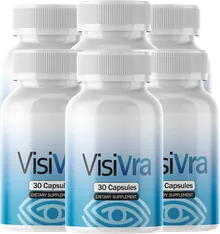
Best Visivra price today: 6 bottles at $49 each (save $780) or 3 bottles at $69 each with free US shipping. One-time payment, no autoship, 60 days to decide.
Check Today’s Discount ›Red flags that end the conversation
- Cure, reverse or “throw away your glasses” claims.
- Fake celebrity or doctor endorsements.
- Free trial with hidden recurring billing.
- No company address, no email, no phone.
- A “clinically proven” label with no study you can name.
The NIH offers the same advice in general: use supplements wisely, tell your health care team and be skeptical of too-good-to-be-true claims (NCCIH; NIH ODS).
Scoring Visivra against the checklist
Because it would be odd not to: Visivra includes lutein and zeaxanthin plus bilberry, astaxanthin, zinc and vitamin A; it’s a one-time payment with a 60-day guarantee. Where it falls short is check #3, because the order page doesn’t publish per-ingredient amounts, so you’d be reading the bottle to judge it. If that is a deal-breaker, see Visivra alternatives. If you’re comfortable checking the bottle, the official page has the details (affiliate link; we may earn a commission).
Compare two labels: a worked example
Imagine two hypothetical products (illustrations, not real brands). Product A lists lutein 10 mg, zeaxanthin 2 mg, zinc 8 mg and vitamin A 300 mcg per capsule, 30 capsules for $30. Product B lists a “Vision Matrix 500 mg” of lutein, bilberry, astaxanthin and others, 30 capsules for $45.
- You can check Product A against the trial amounts (NEI) and total its zinc and vitamin A with your other supplements.
- With Product B, you can’t tell how much lutein is in the 500 mg; it could be almost none. You’d have to ask the seller.
- Price per day: A is $1.00, B is $1.50, but the comparison only means something if you know what you’re getting.
This is why check #3 (published amounts) sits near the top of the list.
An email to send a seller before you buy
Hello, before I order, could you send me the full Supplement Facts panel, including the amount of each ingredient per serving and the form of vitamin A? Also, is there a third-party test for this batch, and what is your refund process? Thank you.
A seller that answers clearly and quickly is telling you something good. One that dodges the question is telling you something too.
Questions
Is more expensive better?
Not necessarily. Compare price per day and the dose you actually get, not the brand.
Do I need third-party testing?
It’s a plus, since the FDA doesn’t approve supplements before sale (FDA). Ask whether a certificate of analysis exists.
What if my doctor says no?
Follow your doctor. They know your medicines and health history, and a supplement is optional.
Before you start anything
Tell your doctor or pharmacist what you plan to take (drug interactions). It takes five minutes and prevents the problems that matter.
FAQ
How do I pick the best eye vitamin?
Match it to your reason for taking it, check that amounts are published, total your vitamin A and zinc, and compare price per day and refund terms.
Should I buy an eye supplement with a free trial?
Be careful. Free trials often hide recurring billing. Prefer a clear one-time price and a written guarantee.
Is a proprietary blend bad?
It isn’t illegal, but it hides how much of each ingredient you get, which makes it hard to judge.
Do I need a doctor’s approval first?
It’s a good idea, especially with a diagnosed eye condition, regular medicines or pregnancy.
Sources
- National Eye Institute (NIH): AREDS/AREDS2 clinical trials
- NCCIH (NIH): Things to know about dietary supplements for eye conditions
- NIH Office of Dietary Supplements: Vitamin A and carotenoids
- NIH Office of Dietary Supplements: Zinc
- FDA: Dietary supplements
- PubMed: 12 weeks of bilberry extract and ciliary-muscle findings in visual display terminal workers (Nutrients, 2020)
- PubMed: Anthocyanin, astaxanthin and lutein on eye functions, a randomized placebo-controlled study (J Clin Biochem Nutr, 2021)
- NCCIH (NIH): Using dietary supplements wisely
- NIH Office of Dietary Supplements: Dietary supplements, what you need to know
General information, not medical advice. Prices and product details come from the official Visivra order page and bottle, checked November 6, 2026; the checkout page and the label on your bottle take priority. Read our disclaimer.